The surface and its preparation
The daguerreotype begins with silver. Not a coating, not an emulsion layered onto glass or paper, but a sheet of copper clad on one face with a thin laminate of pure silver — a material known as Sheffield plate before the process appropriated it. The silversmith's trade fed the photographer's studio, at least until the process gave way to something cheaper.
That silver surface had to be polished to a mirror finish before it could be sensitised. The polishing was not cosmetic: any scratch, any haze, any residue of tarnish would show in the final image with the same fidelity as everything else. Operators used jeweller's rouge, then finer abrasives, working in tight circular strokes until the plate reflected a face as crisply as glass. The sensitivity of the process to contamination meant that the polished plate was handled only at its edges from that point on.
Sensitising happened in a wooden box. The plate was suspended face-down over a dish of iodine crystals, whose vapour rose and combined with the silver surface to form a thin, even layer of silver iodide — a pale gold colour when the fuming was done correctly.
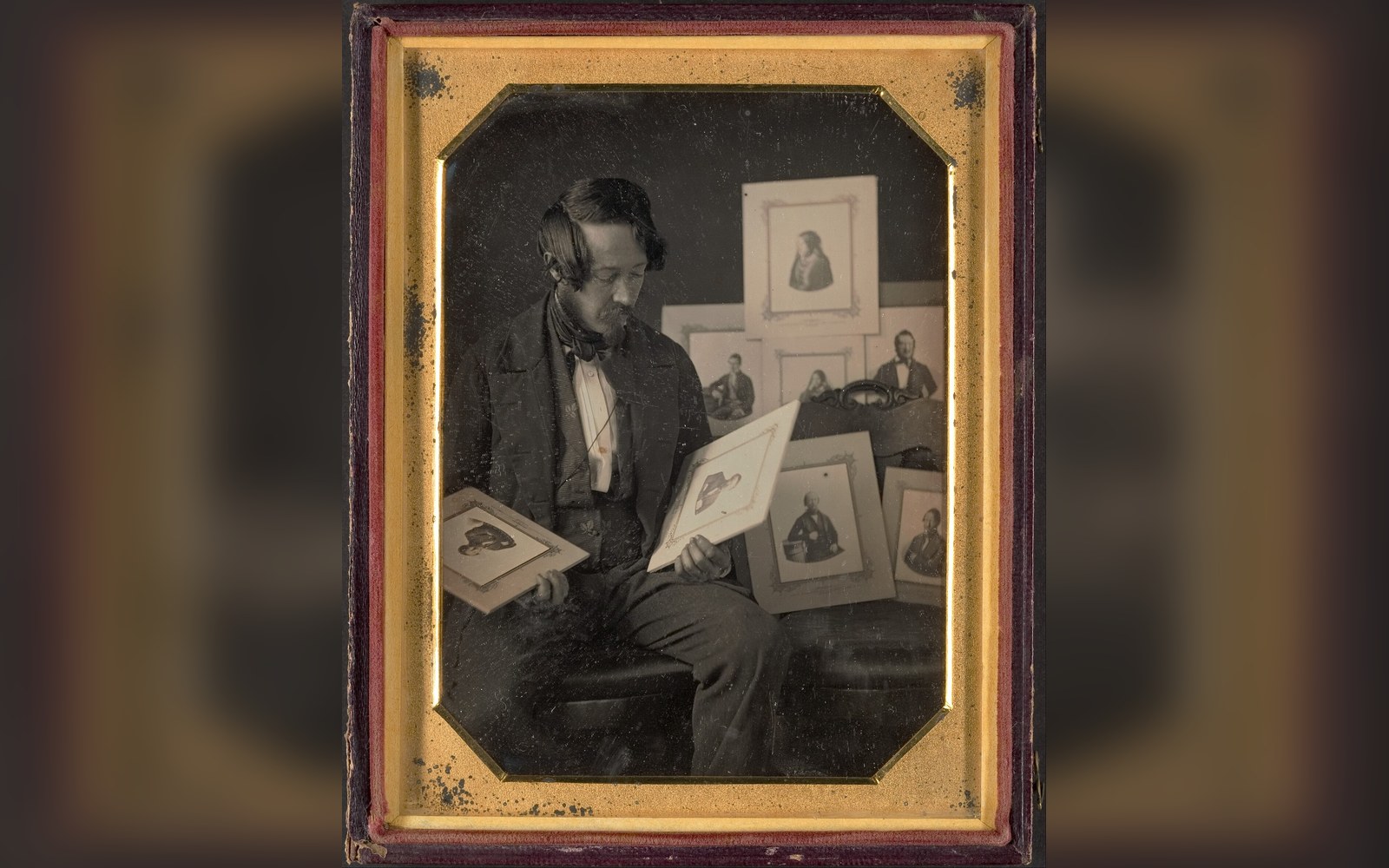
Later refinements added bromine vapour as a second stage, accelerating the sensitivity enough to make portraiture practical; the combination is called a Daguerreotype after Louis Daguerre but the bromine step came from improvements made by Antoine Claudet and others in the early 1840s, within two or three years of the process's public announcement. The sensitised plate was then loaded into a lightproof holder and taken to the camera.
Exposure, development and the mercury chamber
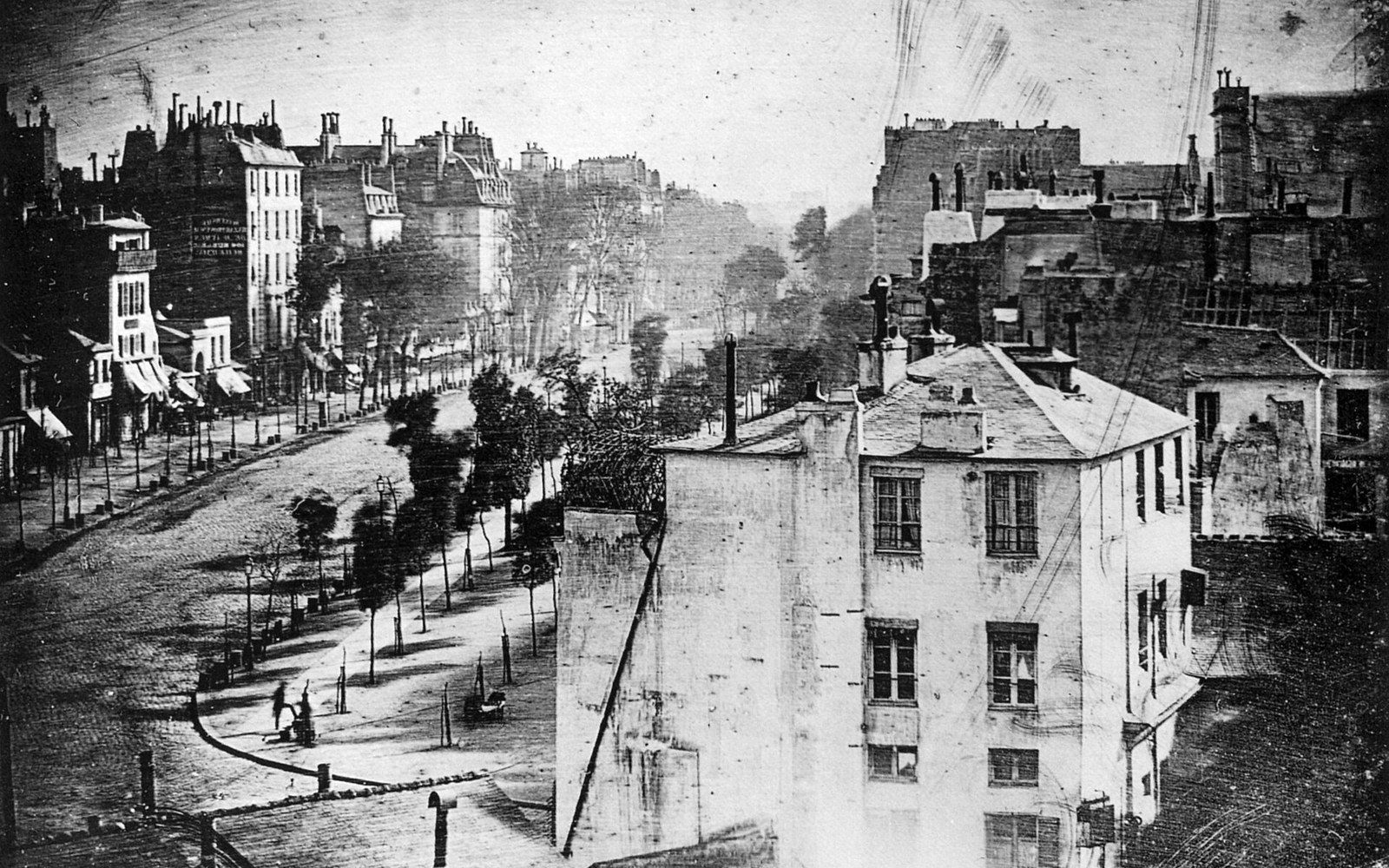
Exposure times in the earliest period were long — several minutes in bright sun, far longer in shadow. What moves disappears in any photograph made at these shutter speeds, and it is why Daguerre's famous view along the Boulevard du Temple, made around 1838, shows a city apparently empty of people. The street was busy; the pedestrians simply did not stay still long enough to leave a mark.
One man, however, was having his boots blacked. Both he and the bootblack were stationary for long enough — several minutes, almost certainly — and they appear at the lower left of the image: the first recorded human beings in a photograph. The detail is incidental, not posed. Nobody knew they were there until the plate was developed.
Development was chemical theatre. The exposed plate went into a second box, this one heated from below by a spirit lamp, over a small dish of liquid mercury. Mercury vapour rises from the liquid at around 60 degrees Celsius and amalgamates selectively with the exposed silver iodide, forming tiny droplets of silver-mercury amalgam wherever light has acted on the surface.
The highlights of the image build first; the shadows, where the iodide was not exposed, remain as bare silver. The operator watched through a yellow glass window in the lid of the box and pulled the plate when the image reached the right density — a judgment made by experience, not by clock.
The image at this stage was still fragile. Unexposed silver iodide remained on the surface and would have darkened in light if left alone. Fixing — removing that residual halide — was done first with a solution of common salt (sodium chloride), then, after improvements suggested by John Herschel reached general practice, with sodium thiosulphate, which dissolved the silver iodide more completely and reliably.
Herschel's contribution to photographic chemistry was essential: his work on thiosulphate as a fixing agent underpins every silver process that followed, right through to gelatin-silver paper used in the twentieth-century darkroom.
After fixing, the plate was gently washed and sometimes toned with gold chloride solution, which improved both contrast and stability, replacing some of the amalgam with metallic gold and giving the shadows a warmer, denser quality. The plate was then mounted behind glass, sealed at the edges, and framed.
The glass was not decorative. The image layer on a daguerreotype is physically fragile — the amalgam sits loosely on the silver surface, and a fingertip drawn across it leaves a permanent smear. The seal that closes the case is also a conservation measure, protecting the silver from atmospheric sulphur.
The mirror and its limitation
The daguerreotype's defining optical quality follows directly from its physics. Because the image is formed in a metallic amalgam sitting on a reflective silver base, it is neither a print nor a transparency in any ordinary sense. It is a direct-positive on a mirror. To read it, you tilt it against a dark ground or hold it so that the silver base reflects something dark behind you; the bright amalgam of the highlights then stands out against the dark reflection in the base, and the tonal scale snaps into clarity.
Tilt it the other way, toward a light source, and the image inverts — the highlights go dark, the shadows go bright — because the bare silver now reflects the light and the amalgam appears relatively dim. No other photographic process behaves this way; the daguerreotype is genuinely unique in its optics.
The highlights of the image build first; the shadows, where the iodide was not exposed, remain as bare silver.
That same physics imposes the process's central constraint: there is no negative. The camera image forms directly on the plate that leaves the camera. To make a second daguerreotype of the same subject, you must photograph the subject again, or photograph the first plate — which degrades quality and reverses the image laterally a second time.
The left-right mirror reversal of the original plate was considered acceptable in portraits (where it echoes what a mirror shows) but less so in images of text, maps or architecture. Prism attachments and mirror reflex systems were designed to correct the lateral flip in the camera, but they complicated the apparatus and reduced the already modest light transmission.
It was this impossibility of multiplication that eventually ended the daguerreotype's dominance. The calotype, Henry Fox Talbot's paper-negative process announced in the same period, could produce any number of positive prints from a single negative. The Musée Nicéphore Niépce in Chalon-sur-Saône holds examples from the 1840s whose detail, examined under a loupe, still astonishes — but sharpness without reproducibility was a commercial ceiling.
When Frederick Scott Archer's collodion process arrived in 1851, it combined the resolution of the daguerreotype with the negative-positive logic of the calotype, and the older process faded from studio use within a decade.
What survived was the daguerreotype's reputation for a quality of likeness that no subsequent process, on paper or glass or film, has quite matched. The amalgam carries detail at a scale finer than any grain structure, because it is not a grain structure at all: it is a continuous metallic surface whose tonal modulation is determined by the distribution of mercury droplets at a molecular level.
Photographers and scientists returning to the process today, working with the same fuming boxes and mercury chambers the nineteenth century used, discover the same thing every operator discovered then — that the material is simultaneously the most demanding and the most unforgiving in the history of the medium, and that the image it yields looks like nothing else.