The surface and its chemistry
Bitumen of Judea — bitume de Judée in the trade catalogues of the period — is a naturally occurring asphalt that has been used as a varnish and ground since antiquity. When dissolved in lavender oil and spread thinly across a smooth substrate, it has a photosensitive property: wherever light strikes it, the bitumen hardens and becomes insoluble.
Where light does not reach, it stays soft and can be washed away with a solvent mixture of lavender oil and white petroleum. The result is a relief of hardened material, dark against the bare metal of the plate. The sensitivity is extremely low — the material responds only to the ultraviolet and near-violet end of the spectrum, and even there it responds slowly.
Nicéphore Niépce, working at his estate of Le Gras near Saint-Loup-de-Varennes ↗, outside Chalon-sur-Saône in Burgundy, had been experimenting with ways to fix the image of a camera obscura throughout the early 1820s. He had tried silver chloride on paper, but could not stop the image continuing to darken after exposure — fixing eluded him with that chemistry. Bitumen was slower, but it solved the permanence problem automatically: once hardened by light, it stayed hardened. What remained after washing was physically stable without further treatment.
The exposure at the upstairs window
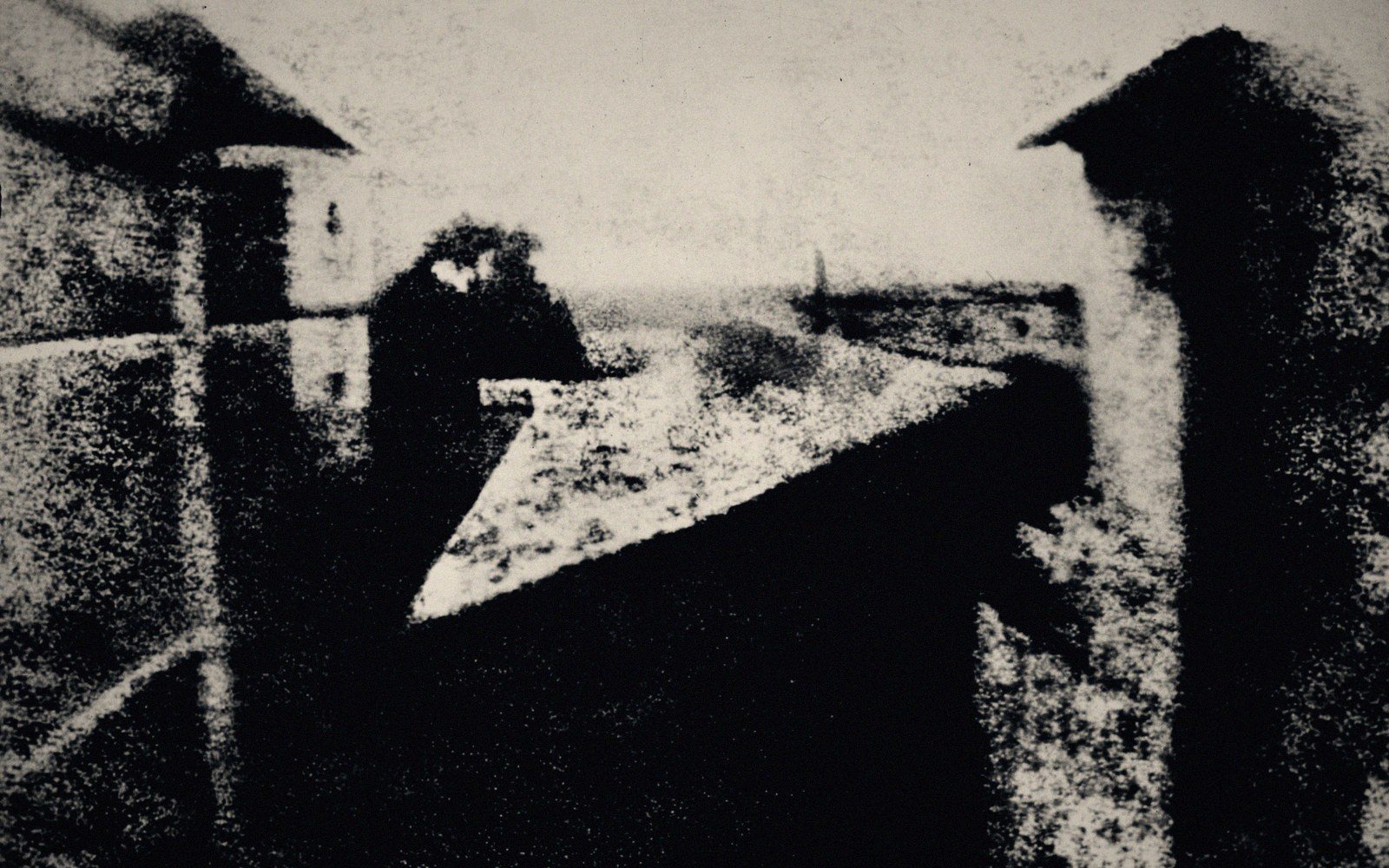
Sometime around 1826 or 1827 — the exact year remains uncertain, and no contemporary document pins it precisely — Niépce pointed his camera obscura out of a second-floor workroom window at Le Gras and exposed a pewter plate coated in bitumen solution. The plate measured roughly 16 by 20 centimetres. The camera's lens was fixed, the plate loaded, and then Niépce waited.
The exposure lasted, by widely accepted scholarly estimate, somewhere close to eight hours. That duration is the physical explanation for the view's strangest quality. Because the sun moved across the sky during the exposure, both sides of the courtyard and the rooftop structures visible in the image received direct illumination at some point.
A façade that faces east and a façade that faces west both record highlights. No single moment of sunlight could produce this. The image is not a frozen instant but a compression of a day: a temporal average printed into asphalt.
After development in the lavender oil and petroleum mixture, the plate showed a faint but legible view — rooftops, a courtyard, the wing of an outbuilding, the open sky. Shadows that any photographer trained on silver materials would expect to read as directional are instead distributed in ways that defy a single light source, because there was no single moment.
The plate is now held by the Harry Ransom Center at the University of Texas at Austin. Examination under raking light reveals the image — it is largely invisible in diffuse illumination, which contributed to early confusion about whether it showed anything at all.
What the plate actually is
Calling it a photograph in the modern sense requires a small adjustment of definition. There is no silver, no gelatin, no halide chemistry of the kind that would define photography for the following century and a half. The image is a physical record of differential hardening in a thin layer of organic material.
Tonal range is extremely compressed; edge sharpness is limited by the long exposure and by the optical quality of the lens; the image is monochromatic and brownish, not black. But the essential transaction — light acting on a prepared surface, a latent structure rendered visible by a subsequent chemical step — is exactly what all subsequent photographic processes repeat.
Bitumen was slower, but it solved the permanence problem automatically: once hardened by light, it stayed hardened.
Niépce called the process heliography, héliographie, sun-writing. The Le Gras plate is the earliest known image made by that transaction still in existence.