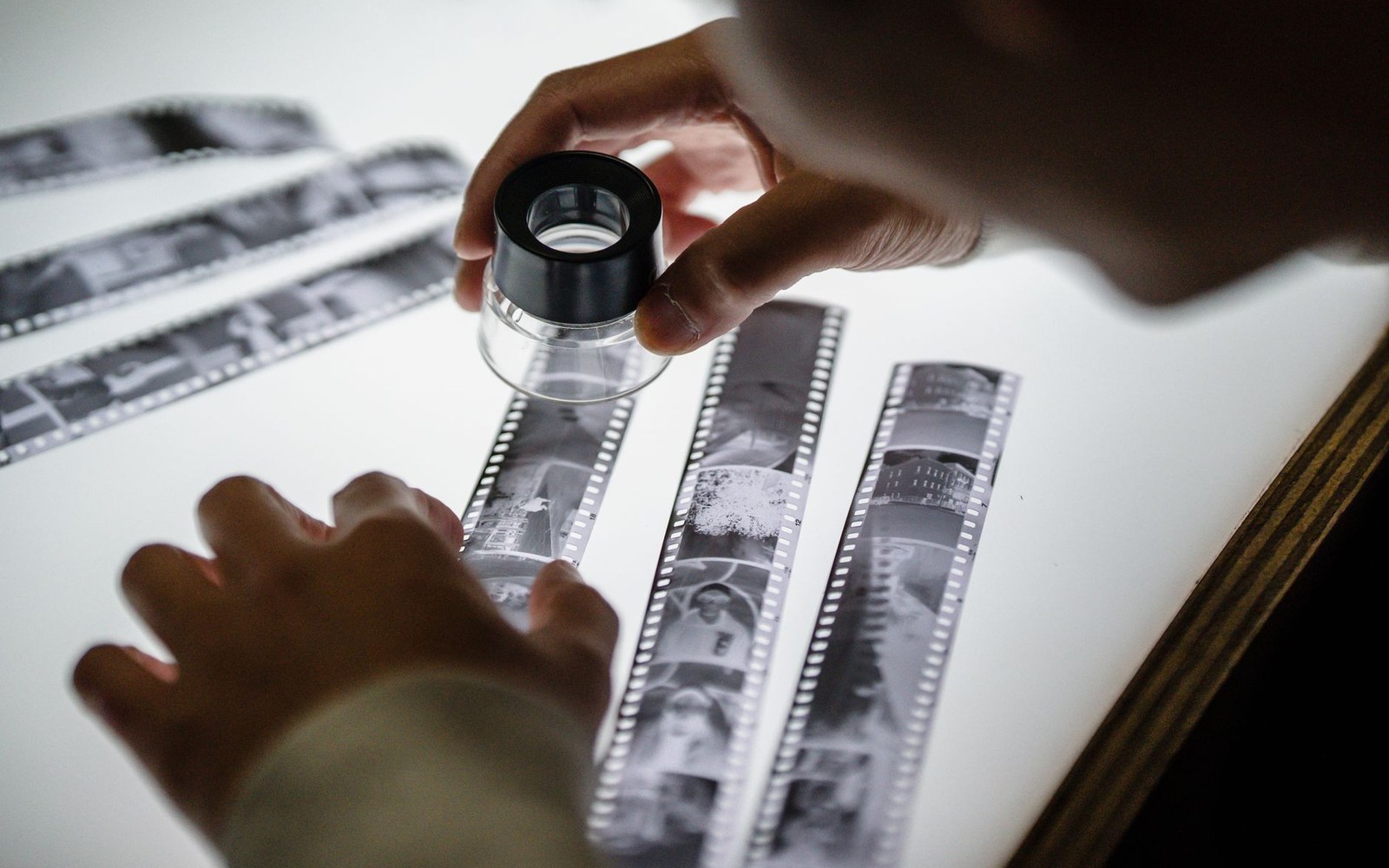
The whole roll, once
A contact sheet is made by laying negatives directly on photographic paper — emulsion to emulsion — and exposing them to white light. No enlarger, no lens: the image is the negative's own size, which for 35 mm means frames roughly 24 × 36 mm, and for a 120 roll perhaps twice that. The result is a grid of small positives, every frame from the roll on a single sheet, developed and fixed like any other print.
The process is straightforward. Negatives, still in their strips, go into a glass-lidded contact printing frame or simply under a sheet of heavy glass. The paper — any fibre-based or resin-coated paper will work, and most photographers use a middle-grade, normal-contrast paper for the job — sits under them, emulsion up. A single exposure under the enlarger's white light, or an overhead lamp, exposes the whole sheet at once. Then it goes through the developer, stop, and fix sequence like any other darkroom print. The whole operation takes minutes.
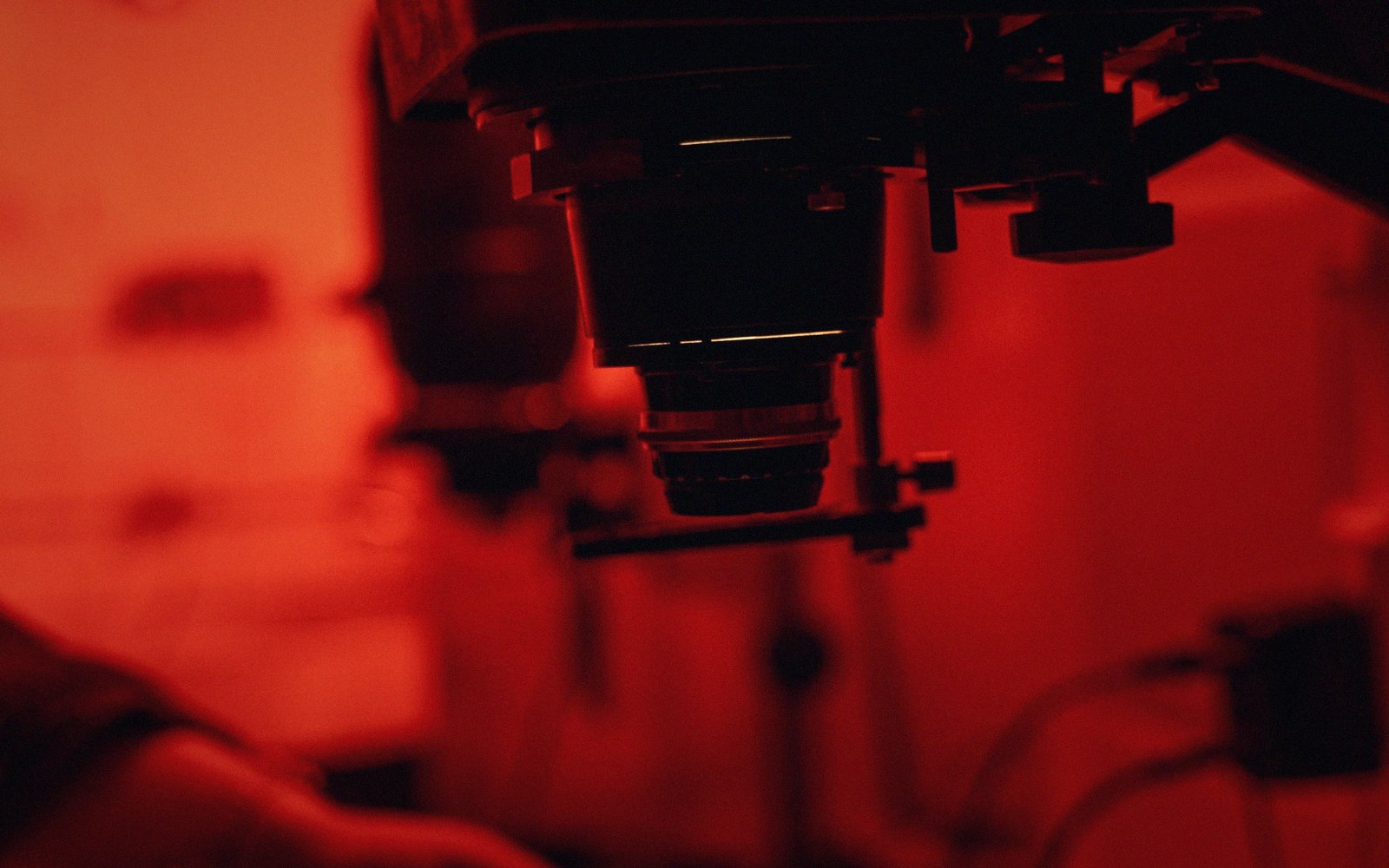
What you get back is evidence rather than art. Tonality, focus and composition are all readable at this scale, just barely. A frame that is badly underexposed will be thin and print dark and muddy; one that is overexposed will be dense and print pale. Motion blur that would ruin an enlargement shows up, if you look closely, even at 35 mm size. A loupe — a small magnifying glass, typically 8× — makes the call definitive.
The chinagraph and what it decides
The editing tool is a chinagraph pencil, a waxy marker that writes on the glossy surface of a developed print. A ring drawn around a frame means it is worth printing. A cross means discard. Some photographers mark exposure compensation directly on the sheet — a note that a particular frame needs to print a half-stop lighter, or that the sky will need burning to hold detail. The contact sheet becomes a map of intention.
This is where selection actually happens. Magnum photographers kept their contact sheets as working documents; the archive of Henri Cartier-Bresson's sheets, held by the Fondation Henri Cartier-Bresson in Paris, shows a decisive eye working frame by frame — a record of judgment as much as of shooting. Eugène Atget made contact prints of his large-format glass plates by the same principle, the contact print being for him essentially the final object.
Digital workflows produce the equivalent in the form of a thumbnail index — every raw file shown at browser size — and the logic is identical: survey the whole take, then commit. The chinagraph may be gone, but the reckoning it represents is not.