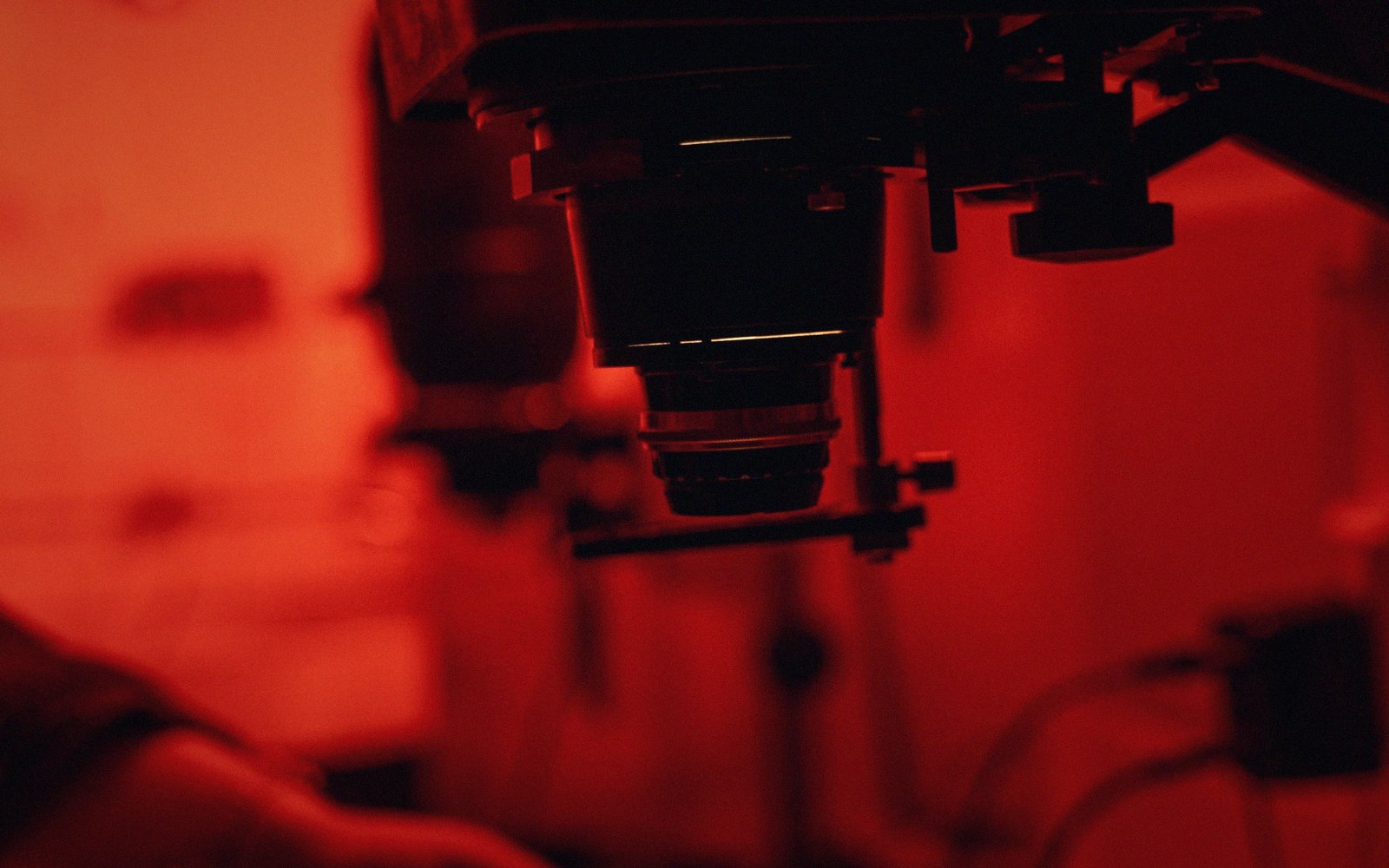
Two ways to move light through a negative, and what each one costs
The light source in an enlarger is not pointed directly at the paper. It passes through a negative first — and the way it is organised before it reaches that negative changes the character of every print the machine makes.
The two dominant approaches are the condenser head and the diffusion head. Neither is wrong. They produce different prints from the same negative, and the difference is not subtle.
How each one works
A condenser enlarger uses one or two plano-convex lenses, typically glass, mounted above the negative stage. Their job is to collect the light from the lamp and concentrate it into a controlled, parallel beam — one that passes through the negative and then through the taking lens on a coherent path toward the paper. The geometry was understood by the time enlargers became standard darkroom equipment in the early twentieth century, and the optical principle has not changed since. The result is directed, specular light: each ray travels a predictable line.

A diffusion enlarger scatters that light before it reaches the negative. The earliest form used an opal glass or ground-glass plate to break up the beam; later cold-cathode and LED heads distribute light across a large mixing box so that the illumination arriving at the negative comes from every direction at once. No single ray dominates. The light is even, soft and non-directional.
The difference in what each method does to the negative — and therefore to the print — comes down to a physical phenomenon called the Callier effect. Any silver-based negative contains not only the silver grains that carry the image but also a scattering component: light hitting a dense area of negative is partially scattered sideways, not just absorbed. A condenser, because it sends coherent directional light through the negative, amplifies those local scattering differences.
Dense areas scatter more; thin areas pass more light. The result is higher effective contrast in the print than the negative's density range would suggest. A diffusion head, because its light already arrives from all directions, is largely indifferent to scatter — a ray deflected sideways by a silver grain simply joins the general field of diffuse light and reaches the paper anyway. The effective contrast is lower.
Practical consequence: the same negative printed on the same grade of paper will produce a print with noticeably more contrast under a condenser than under a diffusion head. This is not a small correction. Darkroom workers who switch between head types routinely find they need to adjust paper grade or variable-contrast filtration by at least half a grade, sometimes a full grade, to match results.
| Condenser head | Diffusion head | |
|---|---|---|
| Grain | Rendered crisply; collimated light casts hard shadows at each clump edge | Softened, because light arrives from all angles |
| Apparent contrast | Higher at the same paper grade | Lower, and flatter in the highlights |
| Dust and scratches | Printed sharply along with everything else | Partly filled in by scattered light |
The condenser also renders grain more crisply — because grain, like every other density variation in the negative, is treated as real information by coherent light — while a diffusion head softens the grain's apparent sharpness slightly by averaging it into the surrounding field.
What each approach is used for
Condenser heads have historically been favoured for black-and-white work where sharpness and local contrast are the goals. They show every scratch and dust particle on the negative with the same merciless clarity they bring to grain, which is why condenser workers treat negative cleaning as a serious step, not an afterthought. The Leitz Focomat and the many Durst heads built for grain-conscious workers both used condensers as their standard.
Diffusion heads — particularly cold-cathode tubes, which became widely available from the mid-twentieth century — are forgiving of surface defects, because dust and scratches do not cast hard shadows under non-directional light. For that reason they became popular in commercial portrait and commercial printing, where retouching time mattered. They are also better matched to colour negative work: dye-based colour negatives lack the scattering silver grain of black-and-white film, so the Callier amplification a condenser would add is less useful, and the even illumination of a diffusion head suits the gentler tonal transitions colour printing demands.
A condenser, because it sends coherent directional light through the negative, amplifies those local scattering differences.
The underlying trade is straightforward. Condenser light is precise, contrasty, revealing. Diffusion light is even, gentle, forgiving. The negative in the carrier is the same piece of film either way. The head above it determines how that film is read.