What grain actually is
Silver halide crystals are not distributed uniformly through a photographic emulsion. They cluster. During exposure, light strikes these crystals and reduces a fraction of their silver ions to metallic silver atoms, forming latent image specks too small to see. Development amplifies those specks into grains of black metallic silver — or, in colour film, into dye clouds that replace them. The result is a population of discrete, randomised particles, and that randomness is structural. It belongs to the physics of the material, not to a failure in technique.
The size of the crystals before exposure determines how visible the grain will be afterward. Fast films — those with a high ISO rating — achieve their sensitivity by using larger halide crystals, which present a bigger target to incoming photons.
The trade is resolution: large crystals clump into coarser, more visible grain. Slow films use smaller crystals, capturing less light but resolving finer detail. This is not a manufacturer's choice so much as a law written into the chemistry: sensitivity and grain travel together, and you pick your position on that curve before you load the camera.
What the enlarger does to it
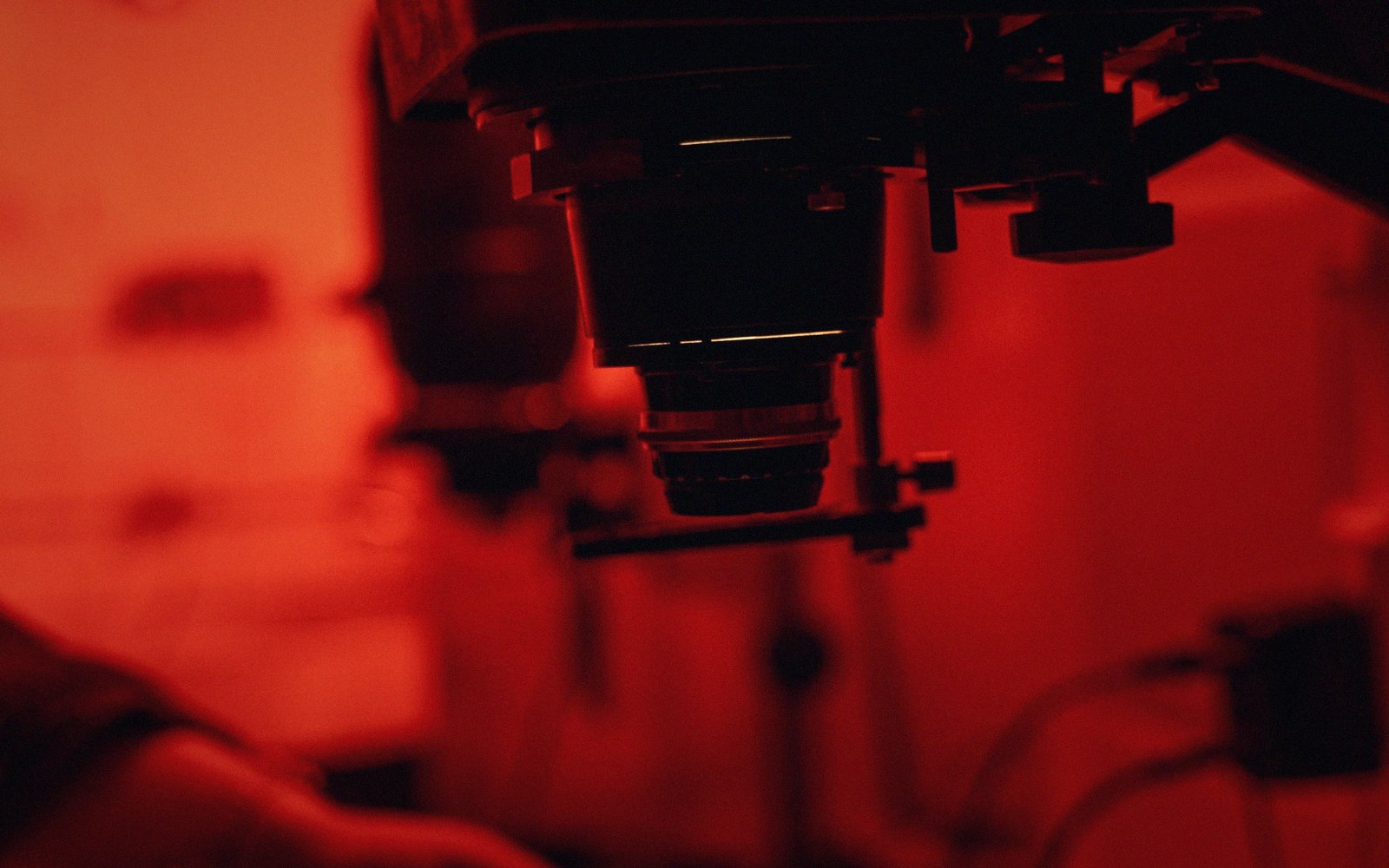
Grain exists in the negative whether you print it or not. At contact-print scale — the full negative projected at 1:1 onto paper — the individual clumps are below the resolving power of the eye and the image appears smooth. The enlarger changes this by magnifying the negative's image circle onto a larger sheet of paper.
At modest enlargements, grain is still largely invisible. Push the magnification higher — printing a 35 mm frame to 40 × 50 cm, say — and the grain structure becomes a visible texture in the final print, most obvious in smooth tonal areas like skin or clear sky where there is nothing else to compete with it.
The enlarger's optical system matters here as much as the magnification ratio. A condenser enlarger directs light through the negative in near-parallel rays, and this collimated beam casts hard shadows at the edges of each silver grain, making grain appear more pronounced than it measurably is. A diffusion head scatters light from all angles, softening those shadow edges and rendering the same negative with visibly less apparent grain. Neither is wrong; they are different interpretations of the same physical structure.
Development decisions compound the effect. Extended development in a high-energy developer — or pushing film beyond its rated speed, forcing development to compensate for underexposure — enlarges the effective grain clusters and increases the clumping of silver. Kodak's HC-110 and Ilford's Perceptol sit at different ends of this spectrum: one trades some grain for speed, the other sacrifices speed for the finest possible grain at box rating. The grain you see in the print is therefore a record of choices made at every stage: emulsion, exposure, development, and finally the enlarger itself.
Reading grain as evidence
Grain is information. A heavily grained print tells you something was pushed — film rated beyond specification, a very fast emulsion, a radical enlargement, or all three. It is part of what the 35 mm camera made possible when Oskar Barnack's Leica, built at the Leitz works in Wetzlar, brought the small negative into serious documentary and street use.
Printing a 35 mm negative to exhibition scale demanded either fine-grained slow film or the acceptance of visible grain as a fact of the format. Many photographers accepted it entirely. The grain in a print by a photographer working in available-light documentary — the coarse, churning texture in a badly-lit interior — is not a concession; it is a direct record of the light that was actually there.
Digital sensors replace halide grain with photosites and noise: a different physical mechanism producing different artefacts, but one that shares the same fundamental trade between sensitivity and fine detail. The underlying logic — that capturing light quickly costs you something in resolution — survives the change of medium intact. Grain in a silver print is not nostalgia. It is evidence of a bet the photographer made before the shutter opened, made physical by the enlarger's light.