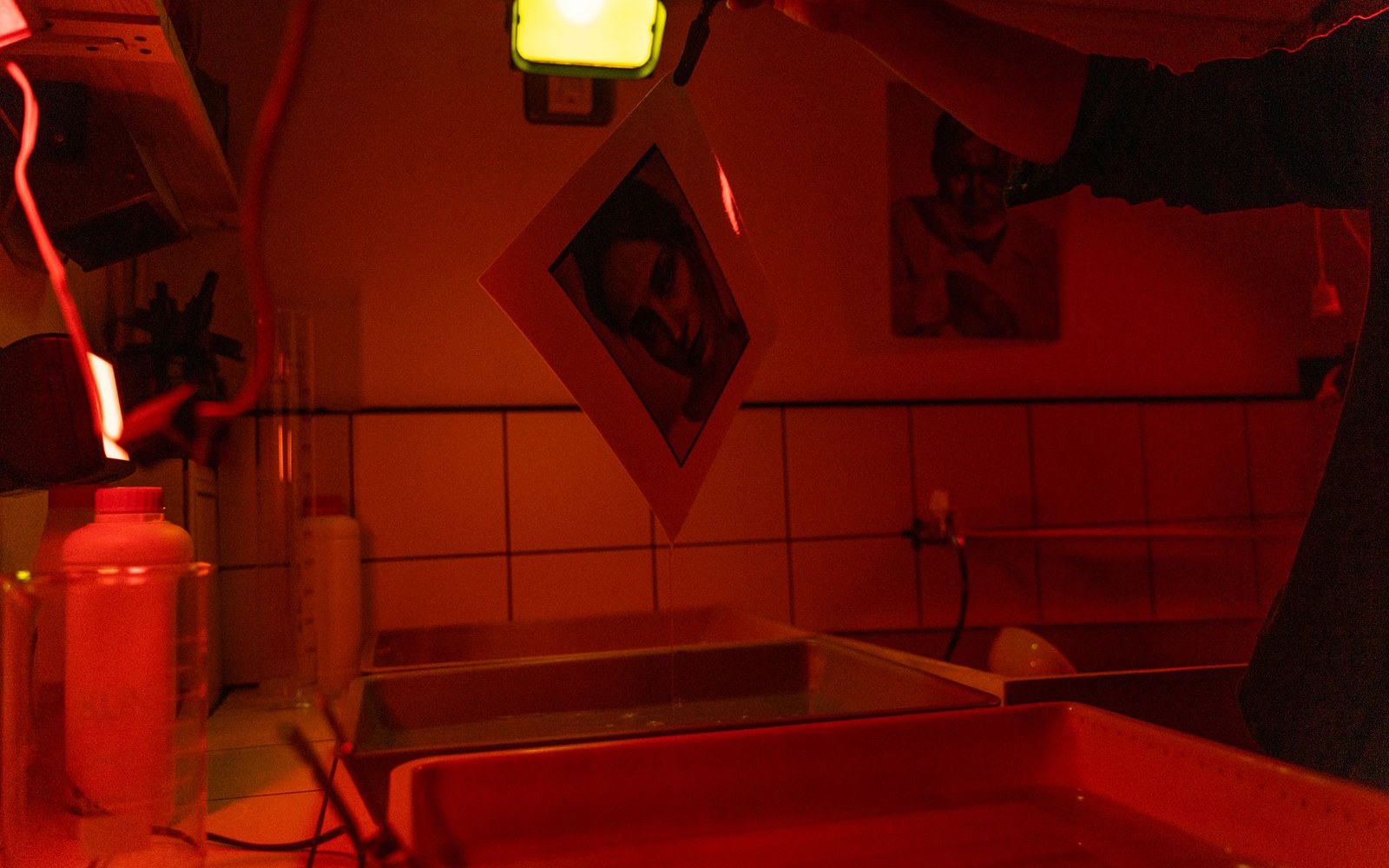
The Order of Things
Film developing can happen in a sealed tank. Printing cannot. To watch an image arrive on paper, you stand at the trays, and the sequence is fixed: developer, stop bath, fixer, wash. Vary the order and the chemistry fights itself. Observe it, and the process is almost entirely predictable.
Developer goes in the first tray. The chemistry — most commonly a hydroquinone and phenidone combination in a working solution such as Ilford Multigrade or Kodak Dektol — reduces the exposed silver halides in the paper's emulsion to metallic silver. Temperature matters: most paper developers are calibrated for 20 °C. Colder, and development slows; warmer, and it accelerates and becomes harder to control.
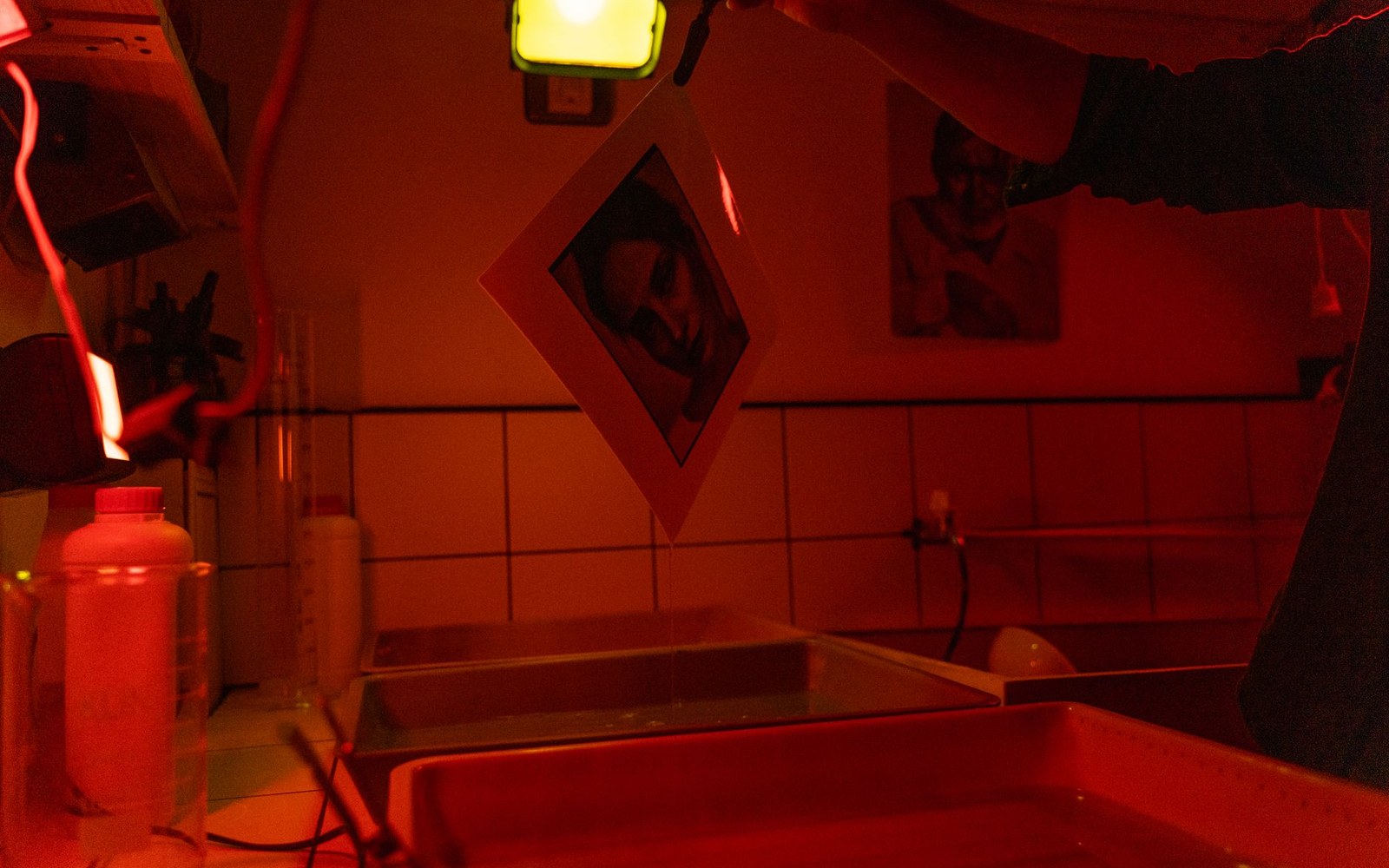
Time matters too. A fibre-base print needs roughly 90 seconds of active development for full shadow density; pulling it early to arrest a print that is coming up too dark is a habit that produces flat, uneven results, because the highlights finish before the shadows do. The correct answer to an overexposed print is a new exposure, not an early pull.
Agitation is not optional. A tray rocked steadily, or a print turned face-down and slid from back to front, keeps fresh developer against the surface and prevents the uneven streaking that exhausted solution leaves behind. The image arrives quickly under a condenser enlarger — the contrast is harder and the grain crisper than under a diffuser head — but in both cases you want to see it come up steadily, not rush.
Stop, Fix, Wash
The stop bath is water, or dilute acetic acid — typically around two per cent. Its sole purpose is to arrest development instantly by neutralising the alkaline developer still in the emulsion. Plain water works; an acid stop works faster and preserves the fixer that follows. Either way, the transfer from developer to stop is the moment that commits the image. Fifteen to thirty seconds of agitation, and the chemistry is neutralised.
Fixer — sodium thiosulphate or ammonium thiosulphate in solution — clears the unexposed silver halide that developer never touched. Without it, the paper would darken completely in room light within minutes. Resin-coated paper fixes in roughly two to four minutes in fresh solution; fibre-base paper, which has an absorbent baryta layer, needs longer, and most workers give it five to eight minutes in two successive baths, the first of which is exhausted first and replaced.
The point of two-bath fixing is simple: you know the second bath is clean, because any carry-over from an exhausted first bath is a known quantity. Incomplete fixing is not visible when you make the print, and it is the reason prints fail decades later.
Wash removes residual thiosulphate from the paper. Resin-coated paper washes in ten minutes in running water because the emulsion sits on a plastic base and the chemistry cannot penetrate far. Fibre-base paper needs at least an hour, sometimes more, because the thiosulphate binds into the paper fibres and diffuses out only slowly. A hypo-clearing agent — sodium sulphite solution — accelerates the process by converting residual thiosulphate into compounds that wash out faster. For archival work, this step is standard.
The Safelight
All of this happens under a safelight. Which colour is safe depends entirely on the paper's spectral sensitivity: most variable-contrast papers are orthochromatic-plus, meaning they are sensitive into the green, and a deep amber or red safelight — the Kodak OC filter is a common reference — is the conservative choice.
Leave a sheet of unexposed paper face-up under the safelight for two minutes, develop it, and if it shows any greyness at all, the safelight is either too bright, too close or the wrong colour. That test costs one sheet and takes ten minutes; skipping it costs a session.
Incomplete fixing is not visible when you make the print, and it is the reason prints fail decades later.
The trays, the temperature, the clock — the sequence looks simple because it is simple, in the sense that gravity is simple. Every variable is real and consequential. Get them right, and the print holds whatever the negative gave the enlarger. Get one wrong, and the error may not show up for years, when the print begins to shift and nothing can be done about it.