The Hand in the Chemistry
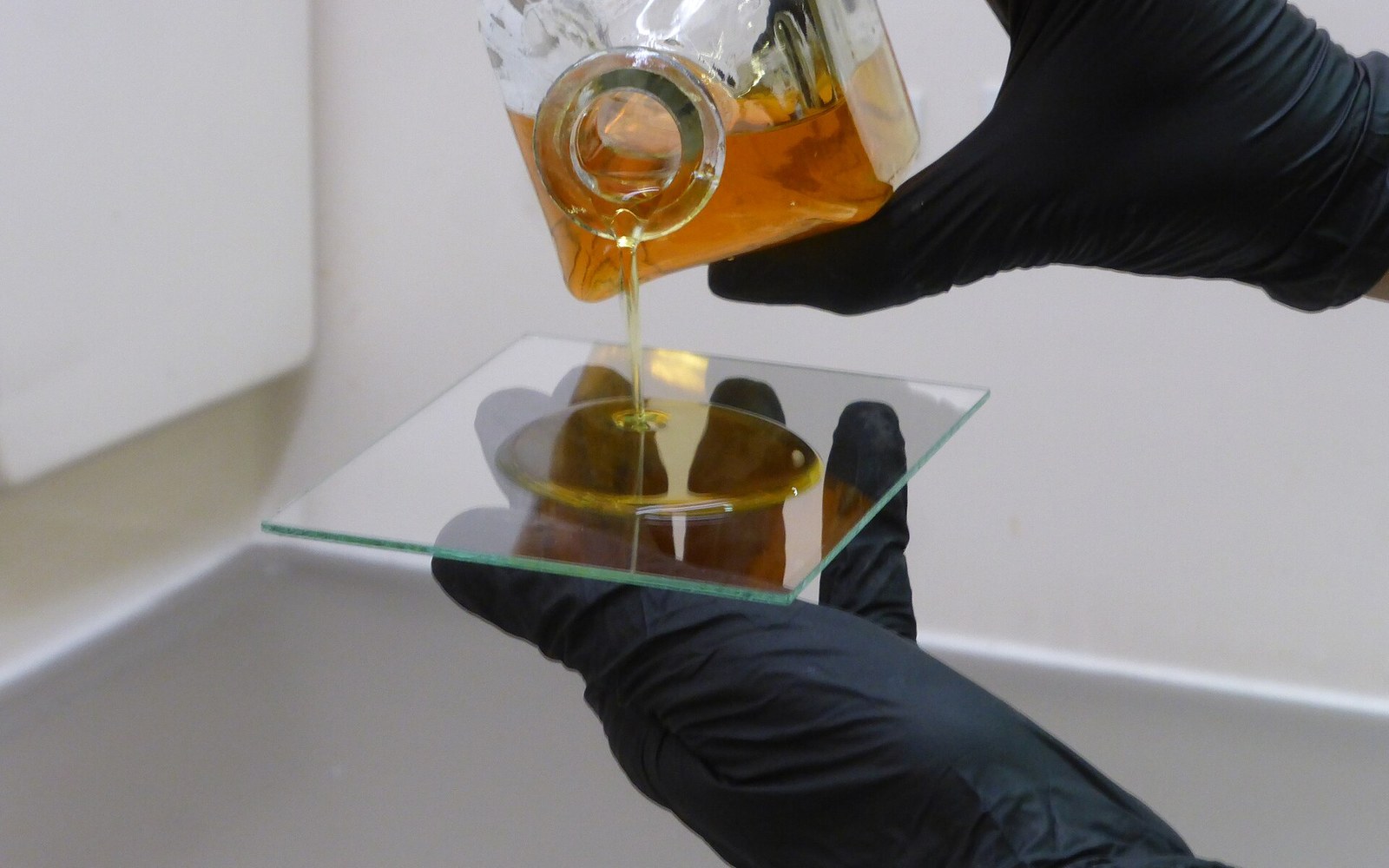
Collodion does not go on a plate the way emulsion comes out of a factory. The photographer pours it from a corner — usually a back corner — then tilts the plate in a practiced sweep to carry the liquid to each edge before it begins to set.
That motion leaves evidence. The pooling at the leading edge, the slight thickening where the pour began, the thinning near the opposite corner: these are not mistakes introduced into the image but the geometry of the coating itself, made permanent by the chemistry that follows.
Bromide drag is the most distinctive of these artefacts. As the collodion sets and the plate goes into the silver nitrate bath, soluble bromides migrate down the surface under gravity. They partially restrain development in the zones they pass through, leaving faint, slightly lighter streaks that run vertically when the plate is held in its final orientation. The photographer who knows the process can read a plate and tell you which way it was held in the bath.
Edge artefacts compound this. Where collodion is thinnest — at the margins, sometimes in a crescent near one corner — the emulsion behaves differently under development. It may fog, streak or hold an uneven density. In a factory-coated material this would be a defect to discard. On a wet plate it is simply the nature of a hand-applied layer, and it reinforces the material reality of the object.
These marks have a further cause: time pressure. Collodion must be coated, exposed and developed before it dries, which means the photographer cannot linger over the pour or correct an uneven tilt. What sets is what you have. The slight urgency is legible in the result.
None of this is accidental in the romantic sense — experienced wet-plate workers develop a consistent pour and hold and produce consistent coats — but no two plates are identical, because no two pours and no two tilts are exactly the same. The variation is structural, not incidental. It is what distinguishes a wet plate from a photographic print made from a digitally even file.
Collodion must be coated, exposed and developed before it dries, which means the photographer cannot linger over the pour or correct an uneven tilt.
The look that follows — silvery highlights that bloom toward the edges, a tonal transition that feels organic rather than geometric, the occasional visible border where the collodion stopped — is now imitated in post-processing software. The imitation flattens the variation into a preset, which is precisely what the original is not. On a real plate, the artefacts have a specific direction, a specific gravity, a specific pour.