The chemistry of a print that keeps
Fixing removes unexposed silver halide from the emulsion, but it leaves behind residual thiosulphate and silver-thiosulphate complexes. Those compounds are stable enough to feel like nothing. They are not nothing. Over years, thiosulphate slowly oxidises and converts back into sulphur compounds that attack the silver image — producing the yellow-brown staining and shadow bleaching known as dichroic fog. The print does not fail suddenly; it fades, stains and loses density in a process that can take decades to become visible and cannot be reversed.
Washing is what removes the residual fixer, and the variables are time, temperature, water flow and emulsion type. Fibre-base paper is the harder case: the baryta layer beneath the emulsion absorbs thiosulphate deeply, and it releases it slowly.
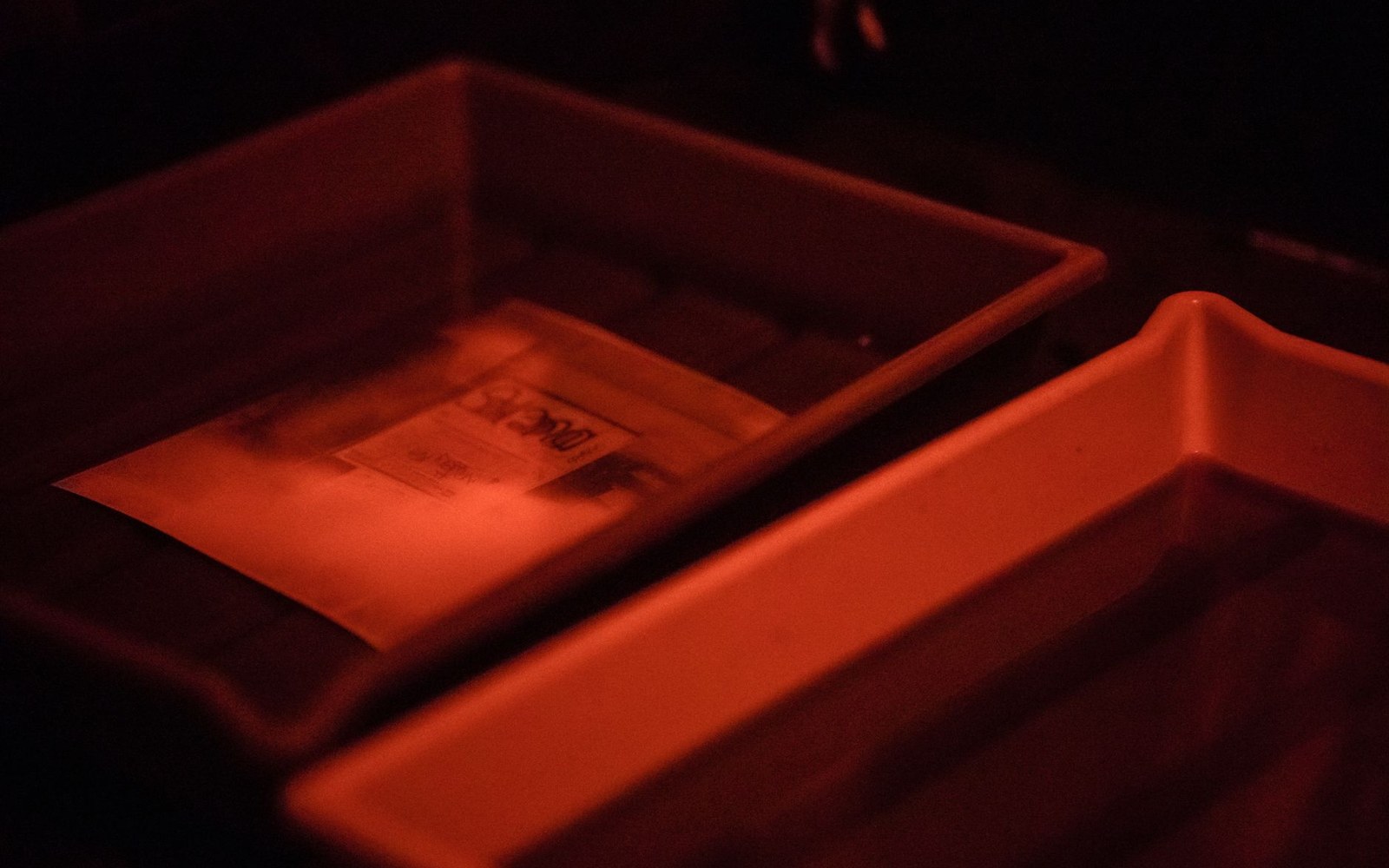
A thorough archival wash for fibre-base requires moving water — not a static soak — and considerably more time than the same wash for resin-coated paper, whose plastic base absorbs almost nothing and clears relatively quickly. Manufacturers' published wash instructions, the better of which have been tested against actual residue measurements, treat these two paper types as a different problem entirely.
Hypo-clearing agents — sodium sulphite solutions, or proprietary products built on the same chemistry — work by converting slow-moving silver-thiosulphate complexes into simpler, more soluble forms that wash away faster. A short soak in hypo-clear followed by a shorter archival wash is chemically equivalent to a far longer plain-water wash, and uses considerably less water. Where archival permanence matters, the step earns its place.
The standard method for testing residual thiosulphate is the residual hypo test, using a silver nitrate solution buffered with acetic acid and sodium acetate applied to a border trimmed from the finished print. Any significant concentration of remaining fixer produces a yellow or brown stain within a defined time; a clean wash produces nothing visible. The ISO 18917 ↗ standard formalises what counts as acceptable residue for archive-grade material. It is not an abstract threshold: museums and collections that guarantee print permanence over a century or more work to it.
Temperature matters too. Water below about 18 °C slows diffusion through the emulsion and baryta layers; a wash that clears adequately at 20 °C may be insufficient at 12 °C for the same duration. A darkroom in winter needs a longer wash or a way to warm the water, not an assumption that the printed time on the bottle still applies.