
The grade is the variable you control
A well-exposed negative carries a full tonal range — dense highlights, translucent shadows, a spread of mid-tones between them. That range, measured as density difference from darkest to lightest, is the negative's contrast. Paper grade is the tool you use to match the print to that range.
Graded papers run from 0 (very soft) through to 5 (very hard). A grade 2 or 3 paper is calibrated to suit a normally exposed and developed negative: the highlight densities of the negative will hold detail in the print, and the shadow densities will hold shadow.
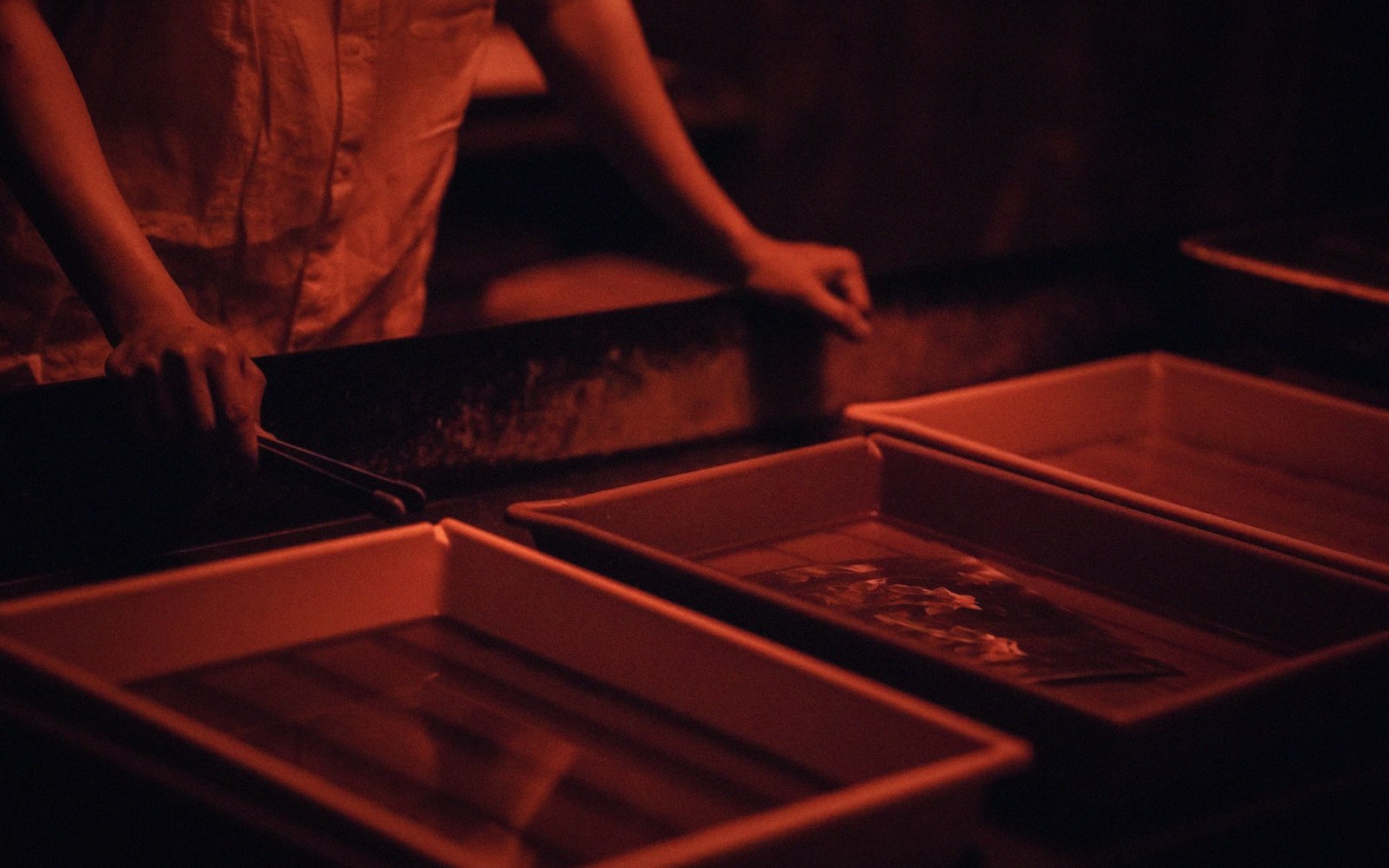
A flat negative — one lacking density range, perhaps from underexposure or underdevelopment — needs a harder grade to stretch its compressed tones into a full-scale print. An overdeveloped, contrasty negative needs a softer grade to keep both ends of the scale within the paper's range.
Variable-contrast paper, introduced commercially in the 1940s and now dominant, collapses the whole graded range into a single box of paper. It carries two emulsion layers, one sensitive to blue light and one to green. Under a blue-filtered exposing light it behaves like a hard paper; under green it behaves soft.
Intermediate filtration produces the grades between. Ilford's Multigrade and Kodak's Polycontrast systems made this practical; in the darkroom today, a set of Ilford Multigrade filters — or a colour enlarger head dialling in yellow and magenta — replaces an entire paper inventory.
The filter can be placed either above the negative, in a filter drawer or colour head, or below the enlarger lens; neither position changes the lens aperture, and a filter below the lens must be of good optical quality so that it does not degrade the image. Below the lens, light has already been focused; the filter changes colour balance only.
What the grade cannot do is manufacture information the negative does not contain. A blank, overexposed highlight is blank on every grade; a featureless shadow remains featureless. Grade selection reveals the negative's tonal range, it does not extend it. Dodging and burning can then push local areas harder or softer still, but those operations work within the limits the grade has already established.
Split-grade printing uses this deliberately: a full exposure at grade 5 builds shadow detail into the deepest part of the tonal curve, then a second exposure at grade 0 opens up the highlights. The two exposures together achieve a local contrast that a single mid-grade exposure would flatten.
Variable-contrast paper, introduced commercially in the 1940s and now dominant, collapses the whole graded range into a single box of paper.
Grade is the first decision at the enlarger. Get it wrong and no amount of burning or dodging recovers it.